
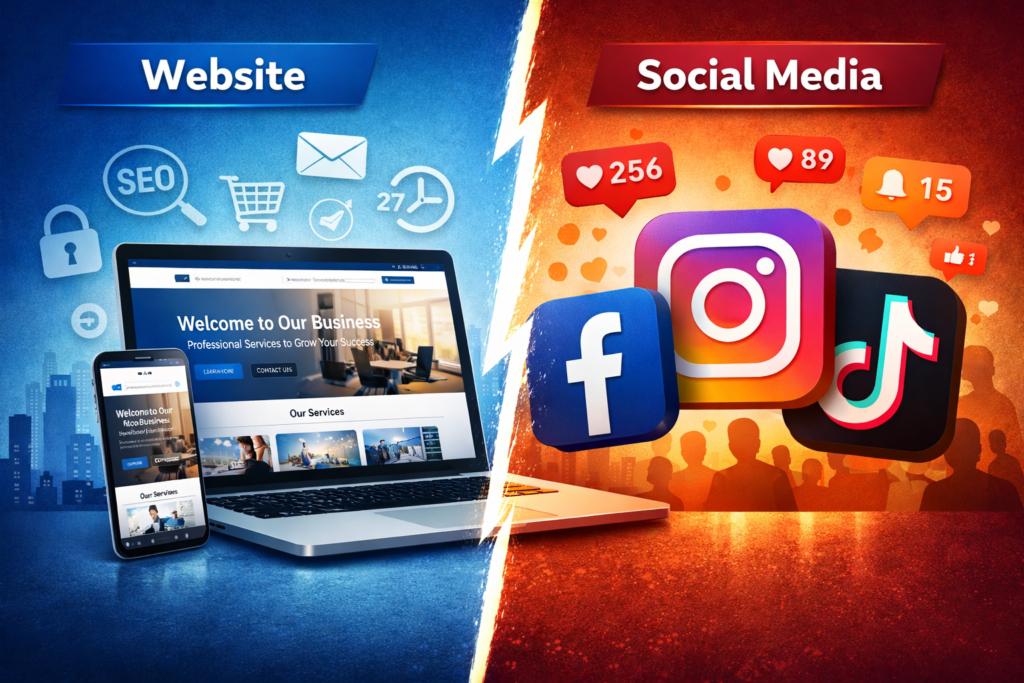
Social media has changed how small businesses market themselves.
You can create an Instagram account in minutes. A Facebook page is free. You can post videos on TikTok, answer questions through WhatsApp and build an audience without having a website at all.
So a reasonable question for a business owner in 2026 is:
Do I really need a website?
For some businesses, social media may be enough to get started.
But if you’re trying to build a business that customers can find on Google, trust, compare and contact, relying entirely on social media can leave some important gaps.
As for a website for UK small businesses, the question isn’t really about choosing between social media and a website.
It’s about understanding what each one is good at.
Social Media Is Useful, But You Don’t Own the Platform
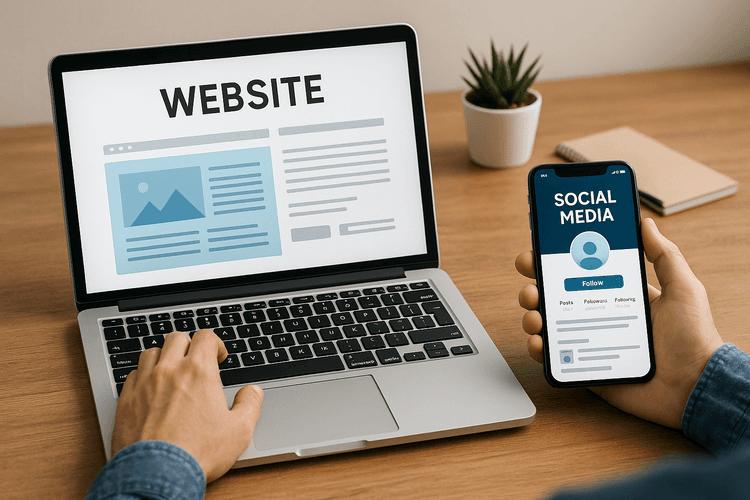
Let’s give social media credit first.
It can be incredibly useful for small businesses.
You can show your products.
You can share customer reviews.
You can demonstrate your work.
You can answer questions.
You can build a community around your brand.
You can even receive enquiries directly through social media.
The problem is that your business does not control the platform.
Facebook, Instagram, TikTok and other platforms control their own systems.
They can change how content is displayed, change their algorithms, introduce new rules or restrict an account.
This is one reason having a website for UK small businesses matters. Your social media presence can support your business, but your website gives you a digital space that you have much more control over.
That doesn’t mean you should abandon social media.
It means you shouldn’t build your entire digital presence on something you don’t control.
Your website gives you a permanent online home that you can manage and build over time.
Your Website for UK Small Businesses Becomes Your Online Home
Think about the difference between having a shop and putting a table outside someone else’s shop.
The table might bring you attention.
But the shop gives you somewhere customers can actually enter, look around and decide what they want.
Your website works in a similar way.
Your social media profiles can attract attention.
Your Google Business Profile can help people discover you.
Your website gives those people somewhere to go next.
For a website for UK small businesses, this can mean having one place where customers can find your services, learn about your company, see your work, read reviews and contact you.
You control the pages.
You control the information.
You control the structure.
And you can change the website as your business grows.
A Website Gives Google More Information About Your Business
One of the biggest differences between social media and a website is search visibility.
Someone might discover your business because they saw an Instagram post.
But another person might never see that post.
They might search Google instead.
For example:
“commercial cleaning company Luton”
or:
“recruitment agency Luton”
or:
“web designer Luton”
A properly structured website gives search engines useful information about what your business does and the areas you serve.
For website for UK small businesses, this means creating clear pages that explain your services, location and what makes your business relevant to potential customers searching online.
That doesn’t mean simply putting keywords everywhere.
Your pages need to provide useful information that matches what potential customers are looking for.
This is one reason web design in Luton businesses invest in should be considered more than appearance.
A good business website should also make it clear:
- What you do
- Who you serve
- Where you operate
- What services you provide
- How customers can contact you
Social Media vs Website: Which One Is Better?
This is where the comparison can become misleading.
It doesn’t have to be one or the other.
Social media is good for reach and engagement.
Your website is good for information, search visibility and conversion.
For a website for UK small Businesses, this is where the two channels can work together instead of competing with each other. Social media can attract attention, while your website gives interested customers somewhere reliable to learn more and take action.
Think about a potential customer seeing your Instagram post.
They like what they see.
What happens next?
They might visit your profile.
Then they might click your website.
Now they can learn more about your services.
They can read your FAQs.
They can look at your previous work.
They can submit an enquiry.
That is a much stronger customer journey than simply hoping the person remembers your social media handle.
The best strategy for many small businesses is therefore:
Social media → Website → Enquiry
rather than:
Social media → Hopefully a customer contacts us.
Your Website Can Help You Capture Leads
This is another area where a website can become valuable.
Imagine someone discovers your business at 10 pm.
Your office is closed.
You aren’t checking Instagram messages.
Nobody is answering the phone.
But your website is still available.
The customer can read about your service and complete an enquiry form.
Depending on your business, you could also allow visitors to:
- Request a quote
- Book a consultation
- Make a booking
- Send an enquiry
- Join an email list
- Download useful information
- Call your business
The website doesn’t replace your staff.
It simply gives potential customers another way to take the next step.
When a website for UK small businesses is built, this can be particularly useful when customers don’t contact you during normal working hours.
A Professional Website Can Build Trust
Imagine you’re comparing two businesses.
Business A has an active Instagram account with good photos.
Business B has an active Instagram account, a complete Google Business Profile and a professional website explaining its services, location, team and contact details.
Which one feels easier to investigate?
The answer won’t always be Business B.
But having a clear website can give customers another place to verify information before they make contact.
A website doesn’t automatically make a business trustworthy.
The content matters.
The design matters.
The information needs to be accurate.
The contact details should be easy to find.
The site should work properly on mobile devices.
But when these things are done well, a website can contribute to a more professional customer experience.
You Can Build an Audience You Can Reach Directly
Social media gives you access to an audience, but the platform controls how that audience is reached.
A website gives you opportunities to build other channels.
For example, you could invite visitors to sign up for an email newsletter.
You could offer a useful guide in exchange for an email address.
You could create a booking system.
You could build a database of enquiries.
This matters because your marketing isn’t completely dependent on someone seeing your next social media post.
You can bring people back to your website through email, search, social media, referrals and other channels.
That’s a much more flexible position for a growing business.
But Do You Actually Need a Big Website?
No.
This is where some web design companies make things unnecessarily complicated.
A small business doesn’t necessarily need 30 pages, animations, complicated features and a huge blog.
Sometimes you need a simple website that does its job properly.
For example, a local service business might need:
Home
A clear explanation of what the business does.
About
Information that helps customers understand who is behind the business.
Services
A clear explanation of the main services.
Contact
Phone number, email, location and an enquiry form.
Reviews or testimonials
Genuine feedback that helps potential customers make a decision.
That’s enough to create a useful starting point for many businesses.
The UK’s 2025 to 2026 Business Data Survey found that 84% of micro businesses and 92% of small businesses reported having a website, showing that websites are already a normal part of the UK’s small-business digital presence.
When Might You Not Need a Website?
Let’s be honest.
Not every business needs to rush out and build a website tomorrow.
If you’re testing a new idea and don’t yet know whether there is demand, social media can be a cheap way to test the market.
If your business is completely based on repeat customers and referrals, a website may not be your most urgent investment.
If you’re operating a temporary stall or short-term project, you may not need a full website either.
But once your goal becomes finding new customers online, the calculation changes.
That’s when a website becomes much more useful.
What About Google Business Profile?
Google Business Profile is extremely useful for local businesses.
It can help customers find your business through Google Search and Maps and gives you a place to manage important information about your company.
But it shouldn’t necessarily replace your website.
Think of it as another part of your online presence.
A potential customer might discover you through Google Maps.
They might read your reviews.
Then they might visit your website to learn more.
That journey works because the different parts of your digital presence support each other.
What Should a Small Business Website Do in 2026?
It doesn’t need to be complicated.
It should be:
Fast.
Customers shouldn’t have to wait unnecessarily for pages to load.
Mobile-friendly.
Your website needs to work properly on smartphones and tablets.
Clear.
Visitors should understand what you do without having to search through the site.
Easy to contact.
Your phone number, email address, enquiry form or booking option should be easy to find.
Useful.
Give visitors the information they need to decide whether your business is right for them.
Search-friendly.
Your pages should clearly communicate your services and locations so search engines can understand them.
That is what a good website for UK small businesses should aim to achieve.
It doesn’t need to be flashy.
It needs to work.
Your Website and Social Media Should Work Together
The real answer to the social media versus website debate is simple.
You don’t have to choose.
Use social media to get attention.
Use your website to give people somewhere reliable to go.
Use Google to help people discover you.
Use your website to turn that interest into an enquiry.
For example:
Instagram post
↓
Potential customer discovers your business
↓
Customer visits your website
↓
Customer learns about your service
↓
Customer reads reviews
↓
Customer submits an enquiry
That is a much stronger digital journey than relying on one social media account to do everything.
So, Do You Really Need a Website in 2026?
For most UK small businesses that want to attract new customers online, yes, a website is still worth having.
The important point is that you don’t need to build something unnecessarily complicated.
You need a website that gives your customers a clear place to learn about your business, find your services, trust what you offer and take the next step.
Social media is still valuable.
Keep using it.
Post your work.
Talk to your customers.
Build your audience.
But give that audience somewhere to go.
A good website for UK small businesses can become the central point that connects search, social media, referrals and direct enquiries.
Get a Fast, Mobile Website with IvyHive
If your business is relying entirely on social media, or your current website is slow, outdated or difficult to use, IvyHive can help.
Get a free consultation and let’s discuss what your business actually needs.
FAQs
Do I need a website for my small business in 2026?
For most small businesses that want to attract new customers online, a website can be a valuable part of their digital presence. The UK’s 2025 to 2026 Business Data Survey found that 84% of micro businesses and 92% of small businesses reported having a website.
Is social media enough for a small business?
Social media can be extremely useful, but it is not enough on its own for many UK small businesses. Relying on social media alone means depending on platforms you don’t control. A website for UK small businesses gives your business a permanent online destination that you can manage, build on and connect to your social channels.
What is better, social media or a website?
They serve different purposes. Social media is useful for reaching and engaging audiences, while a website can provide detailed information, support search visibility, and capture enquiries. For many businesses, using both is more effective than choosing one.
How much does a small business website need to include?
It depends on the business, but many small businesses can start with a simple website containing a homepage, about page, services, contact information and customer reviews or testimonials.
Does a website help a business appear on Google?
For a website for UK small businesses, having a website is an important starting point for building an online presence, but it is not a guarantee of Google rankings. A website gives search engines information about your business and its services. However, simply having a website does not guarantee rankings. Your content, technical performance, relevance, authority and other factors all matter.
Do I need a website if I already have Google Business Profile?
Google Business Profile and a website can complement each other. Your Business Profile can help customers discover you on Google Search and Maps, while your website can provide more detailed information about your business and services.